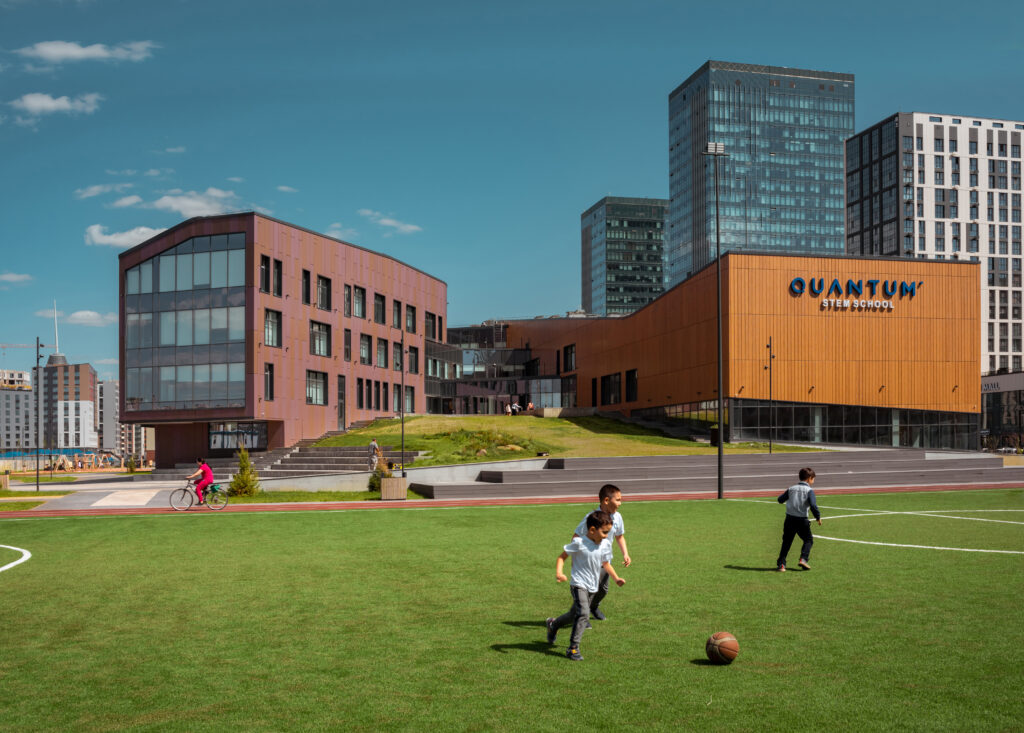
School in Kazan
- location
- Russia, Kazan
- design
- 2019
- site area
- 0,8 ha
- total area
- 518 351 m²
- number of students
- 330
For us, the project of a school for 330 students began with a question: what should a contemporary school be like for a child to perceive it as a meaningful part of their life? ATRIUM’s architects proceeded from the understanding that educational architecture today must compete for attention not only functionally, but emotionally as well. A school can no longer be a a neutral shell for the educational process, it must become an environment that engages, shapes identity, awakens curiosity and gives a child the sense that something important is happening precisely here.
The architects deliberately moved away from the linear model of an educational building, where everything is subordinated to frontal teaching and a rigid typology. Instead, an environment was created with multiple scenarios: for learning, communication, individual concentration, public activity, creativity, movement and contemplation. It was important for us that a child should be able to experience the school in different ways throughout the day, and that the space itself should support a diversity of educational trajectories. In this sense, the school is designed almost as a small city — with a public centre, its own routes, squares, transitions and spaces of varying degrees of openness.
The concept is based on the principles of multiple intelligences, translating different models of perception and cognition into architectural scenarios. Thus, the library and media library become spaces for discussion and independent work; the sports core becomes a zone of physical activity and coordination; the assembly hall and music classrooms become platforms for performance and creative practice; while the green areas, garden and orangery support exploratory and naturalistic experience. In this project, the school is understood as an environment that responds to the diversity of children’s abilities and helps each pupil build their own path of development.
The project is also embedded in the urban and cultural context of Kazan. In working with form and graphic language, we drew on the ornamental code characteristic of Tatarstan, on the fluidity of lines and on natural motifs. The flower became the conceptual image — a symbol of growth, flourishing, youth and the unfolding of potential.
At the same time, the project is not limited to the school function alone. The building incorporates an autonomous development centre oriented also towards the residents of the Art City residential complex, thereby acquiring the status of a neighbourhood public centre.
idea


drawings